For years, creators focused almost entirely on one monetization model: platforms.
Post content.
Grow followers.
Hope the algorithm cooperates.
Convert a small percentage into paying subscribers.
That model still works – but it’s incomplete.
In 2026, creators who build sustainable income don’t rely on one revenue stream. They diversify. And one of the most scalable, controllable, and high-margin ways to do that is selling digital products online.
Digital products don’t require shipping.
They don’t require inventory.
They don’t depend on platform mood swings.
And once created, they can sell repeatedly – 24/7.
An ebook can be sold 10 times or 10,000 times.
A preset pack can be downloaded globally in seconds.
A course can generate income long after launch.
That’s leverage.
But here’s the part most creators miss:
Creating a digital product is only half the equation.
The real advantage comes from how you structure the sales flow.
Traffic still starts on social platforms.
Discovery still happens on Instagram, TikTok, YouTube, or X.
But monetization should not depend on a single platform link.
This is where infrastructure matters.
Instead of:
- Social Media → Random Storefront → Hope
Smart creators build:
- Social Media → GetMy.Link → Structured Offer → Digital Product → Retention
That middle layer – your GetMy.Link page – becomes your control center.
It organizes your offers.
Captures leads.
Tracks behavior.
Lets you test pricing and messaging.
And gives you flexibility without changing your social bio every time you launch something new.
Selling digital products online isn’t just about uploading a PDF and adding a price tag.
It’s about:
- Choosing the right product type
- Structuring your offer clearly
- Setting up automated delivery
- Building a smooth conversion path
- Tracking performance
- Retaining buyers for future launches
In this guide, we’ll break down:
- Why digital products are exploding in the creator economy
- What types of digital products sell best
- Step-by-step how to build and launch one
- How to price for profit
- How to use GetMy.Link as your centralized sales hub
- And how to turn one-time buyers into long-term customers
If you’re a creator who wants more control, higher margins, and income that doesn’t depend entirely on subscriptions – this is your next move.
Let’s start with the fundamentals.
Why Digital Products Are a Natural Fit for Creators in 2026
Creators already do the hardest part.
You build attention.
You build trust.
You build audience.
Digital products simply turn that trust into structured value.
In 2026, the creator economy has matured. Audiences don’t just want content – they want solutions, tools, access, education, and shortcuts. That demand makes digital products a natural extension of what creators already provide.
You’re not starting from zero.
You’re monetizing what you already know.
Zero Inventory, High Margin
Physical products require:
- Manufacturing
- Storage
- Shipping
- Returns
- Customer service logistics
Digital products require:
- Creation
- Setup
- Automated delivery
Once built, the cost of selling one more copy is almost zero.
That’s margin.
An ebook that takes two weeks to create can sell for years.
A template pack can be resold unlimited times.
A video course can generate income without additional labor.
For creators, this is leverage.
You Already Have Niche Authority
Creators often underestimate how much value they hold.
If you:
- Grew a following
- Built a personal brand
- Learned editing techniques
- Mastered a content niche
- Developed a workflow
- Solved a specific problem
That knowledge is a product.
Your audience often wants:
- “How did you do that?”
- “What tools do you use?”
- “Can you teach me?”
- “Do you have a guide?”
Digital products answer those questions at scale.
Instead of repeating yourself in DMs, you package the answer once.
Independence From Platform Risk
Algorithms change.
Monetization rules shift.
Accounts get restricted.
Revenue splits evolve.
When your income depends entirely on one subscription platform, you’re exposed.
Digital products diversify that risk.
Even if:
- Your reach fluctuates
- One platform slows down
- Policies change
Your product still exists.
And when you structure your sales through a centralized hub like GetMy.Link, you don’t depend on a single storefront. You control the flow.
Social traffic comes in.
Your link hub organizes it.
Your product sells.
That flexibility is protection.
Scalable Without More Time
One of the biggest constraints creators face is time.
More custom content means more hours.
More live sessions means more energy.
More DMs means more manual work.
Digital products scale without increasing workload.
You create once.
You automate delivery.
Sales happen while you sleep.
With proper structure – including automated delivery links and organized sales pages – your system runs continuously.
That’s the shift from trading time to building assets.
Perfect for Audience Layering
Not every follower is ready for a subscription.
Some want:
- Low-cost entry
- Educational content
- Templates
- Behind-the-scenes workflows
- Beginner-friendly material
Digital products allow tiered monetization.
Example:
- Free content → $9 guide → $49 course → $199 advanced bundle
That layered model increases lifetime value per follower.
And when structured correctly using GetMy.Link, you can:
- Prioritize new launches
- Feature limited-time bundles
- Reorder offers
- Add pre-sale pages
- Track which product performs best
You’re no longer limited to one revenue button.
The 2026 Buyer Behavior Shift
Buyers today expect:
- Instant access
- Clear value
- Mobile-friendly delivery
- Smooth checkout
- Professional presentation
If your digital product is powerful but your funnel is messy, conversion drops.
That’s why structure matters as much as content.
A clean GetMy.Link page can:
- Present your digital product clearly
- Separate it from other offers
- Capture emails before purchase
- Organize launch campaigns
- Provide analytics to refine messaging
The product is value.
The structure is leverage.
Digital products aren’t a trend.
They’re a structural evolution in how creators monetize.
Instead of depending entirely on subscriptions, you build assets.
Instead of chasing algorithm spikes, you build predictable funnels.
Instead of hoping followers convert, you guide them through organized offers.
Next, let’s break down the most profitable types of digital products creators can sell – and how to choose the right one for your audience.
Top Digital Products Creators Can Sell (With Real-World Examples)
Not all digital products are created equal.
Some require months of work.
Some can be built in a weekend.
Some scale fast.
Some are better as upsells.
The key is choosing a product that matches:
- Your audience
- Your expertise
- Your content style
- Your long-term positioning
Below are the most effective digital product categories for creators in 2026 – and why they work.
Ebooks, Digital Guides & Checklists
Best for:
- Creators with strong niche knowledge or repeat audience questions.
This category isn’t just about long-form ebooks.
It also includes:
- Short guides
- Checklists
- Step-by-step playbooks
- Resource lists
- Starter kits
- Swipe files
- Roadmaps
- “How-to” blueprints
Sometimes a 100-point checklist converts better than a 100-page ebook.
Why?
Because buyers often want clarity – not volume.
Examples:
- “How I Grew to 100K Followers in 6 Months” (step-by-step guide)
- “30-Day Content Posting Plan”
- “Camera Setup Checklist for Beginners”
- “Creator Launch Roadmap”
Short, focused documents solve immediate problems.
And immediate problems sell.
Why This Category Works?
Guides and checklists:
- Are fast to create
- Require minimal production cost
- Deliver immediate value
- Are easy to consume
- Have low refund friction
- Convert well at lower price points
They also act as entry products.
A checklist can lead to:
- Guide → Course → Advanced Program
Layered monetization.
Production Tools:
- Canva
- Google Docs
- Notion (export to PDF)
- ChatGPT-assisted drafting + manual refinement
Design matters – but clarity matters more.
Pricing Range:
- Checklists: $5-$19
- Guides: $9-$39
- Bundles: $29-$79
Micro-products convert well when structured properly.
How GetMy.Link Helps
You can:
- Create a dedicated button (“Download the Checklist”)
- Add a preview page
- Collect emails before purchase
- Host the file securely
- Bundle multiple PDFs under one CTA
- Track which traffic source drives the most downloads
Instead of sending traffic randomly, you create:
- Social Media
↓
GetMy.Link
↓
Focused Offer
↓
Instant Digital Delivery
That structure turns small PDFs into scalable assets.
Templates & Toolkits
Best for:
- Creators who use repeatable systems.
Examples:
- Notion dashboards
- Editing presets
- Lightroom filter packs
- Social media calendar templates
- Budget spreadsheets
- Canva design kits
Why it works:
Templates remove friction for buyers. Instead of learning from scratch, they download your system.
Templates often sell better than theory because they are immediately usable.
Pricing range:
$9-$79 depending on complexity.
Scalability:
Very high. Zero fulfillment cost after creation.
How GetMy.Link helps:
You can:
- Host file links directly
- Bundle multiple templates
- Run limited-time promotions
- Move your featured product to the top during launches
Online Courses & Mini Workshops
Best for:
- Creators with structured teaching ability.
Examples:
- Editing masterclass
- Content monetization course
- Fitness transformation program
- Photography lighting workshop
- Beginner influencer roadmap
Courses offer higher price points because they deliver deeper transformation.
Pricing range:
$49-$499+
Delivery options:
- Hosted course platforms
- Private membership access
- Video series downloads
How GetMy.Link fits:
- Feature the course as your primary CTA
- Add testimonials section via static page
- Segment traffic (Beginner Course vs Advanced Course)
- Track which audience converts better
Digital Assets & Creative Packs
Best for:
- Designers, photographers, musicians, editors.
Examples:
- Stock photo bundles
- Sound packs
- LUT packs
- Graphic element kits
- Digital art downloads
- Icon libraries
Why it works:
Creative buyers constantly look for assets to speed up production.
Digital assets sell globally with no shipping, no barriers.
Pricing range:
$5-$99+
With GetMy.Link:
- Organize product categories
- Promote seasonal asset drops
- Use short links for campaigns
- Add QR codes for offline promotion
Upload and deliver digital files directly – including full packs of photos, fonts, presets, PDFs, or templates – and generate secure download links for buyers.
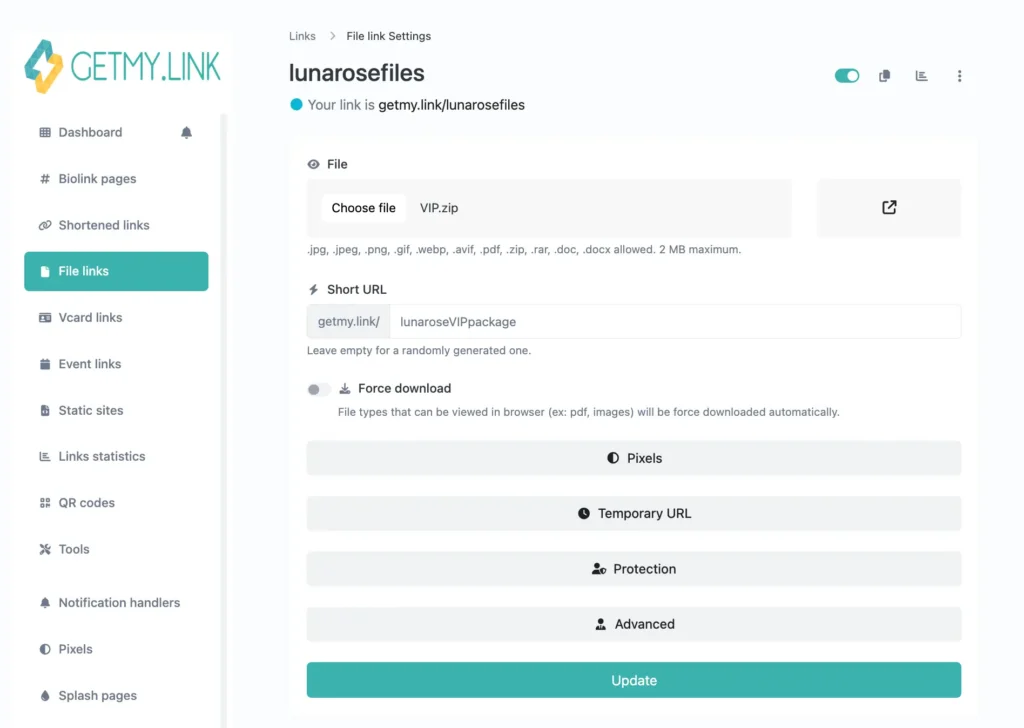
(File link creation screen in GetMy.Link showing a ZIP file upload, custom short URL, and advanced options.)
Membership Add-Ons & Tiered Digital Offers
Best for:
- Creators who already monetize through subscriptions, one-time sales, or premium access platforms.
Instead of depending on a single revenue stream, you can layer multiple digital offers on top of your main monetization model.
For example:
- Core subscription or main product
- Premium resource pack
- Exclusive digital bundle
- Advanced version of a guide
- Members-only download set
- Early-access content tier
This creates a value ladder instead of a single entry point.
Entry Offer → Premium Upgrade → High-Tier Bundle
That structure increases:
- Average order value
- Lifetime customer value
- Monetization flexibility
How GetMy.Link supports this:
- Separate free vs premium offers
- Add a clear “Upgrade to Premium” button
- Launch limited-time digital bundles
- Promote add-ons without changing your bio link
Micro Products (Fast to Build, Fast to Sell)
Micro-products are low-cost, focused offers.
Examples:
- $9 Starter Pack
- $5 Checklist
- $12 Quick Course
- $15 Content Planner
They reduce buying resistance.
Micro-products convert well when:
- Traffic volume is high
- Audience is new
- You want easy entry offers
With proper structure through GetMy.Link, micro-products become a traffic filter.
High intent buyers upgrade later.
How to Choose the Right Product
Ask yourself:
- What does my audience ask about most?
- What problem can I solve quickly?
- What do I repeat often?
- What system do I use daily?
- What transformation can I package?
Your first digital product should not be perfect.
It should be clear.
Clarity converts better than complexity.
Product + Structure = Sales
The mistake creators make is thinking:
- “If I build it, they will buy”.
That’s incomplete.
The correct model is:
- Product + Structured Funnel = Sales
You need:
- Clear offer
- Clean presentation
- Organized link hub
- Smooth delivery
- Analytics to improve
This is where GetMy.Link becomes your control center.
Instead of scattering your digital products across random platforms, you centralize:
- Social Traffic
↓
GetMy.Link
↓
Organized Product Offers
↓
Purchase
↓
Retention
Next, we’ll walk through exactly how to build and launch your first digital product step-by-step – from idea to automated sales.
Step-by-Step: How to Create and Launch a Digital Product
Ideas are everywhere.
Execution is rare.
Selling digital products online isn’t complicated – but it requires structure. Below is a practical roadmap creators can follow to move from concept to consistent sales.
Step 1: Identify a Specific Problem
The best digital products solve one clear problem.
Not five.
Not “everything about my niche”.
One.
Bad idea:
- “The Ultimate Guide to Everything About Content”.
Better idea:
- “How to Edit Viral Reels in Under 15 Minutes”.
Clarity increases conversion.
To find your product idea, look at:
- DMs and comments
- Frequently asked questions
- Tutorials you repeat often
- Pain points your audience mentions
- Tools people ask you about
If people keep asking you something, they’re signaling demand.
That’s product validation.
Step 2: Validate Before Building
Before you spend weeks creating something, test interest.
You can:
- Run a poll in stories
- Ask your audience directly
- Create a waitlist
- Offer pre-orders
- Share a preview outline
Validation reduces risk.
With GetMy.Link, you can create:
- A “Coming Soon” page
- A waitlist form
- An email capture block
- A pre-launch landing page
This allows you to measure real interest before building fully.
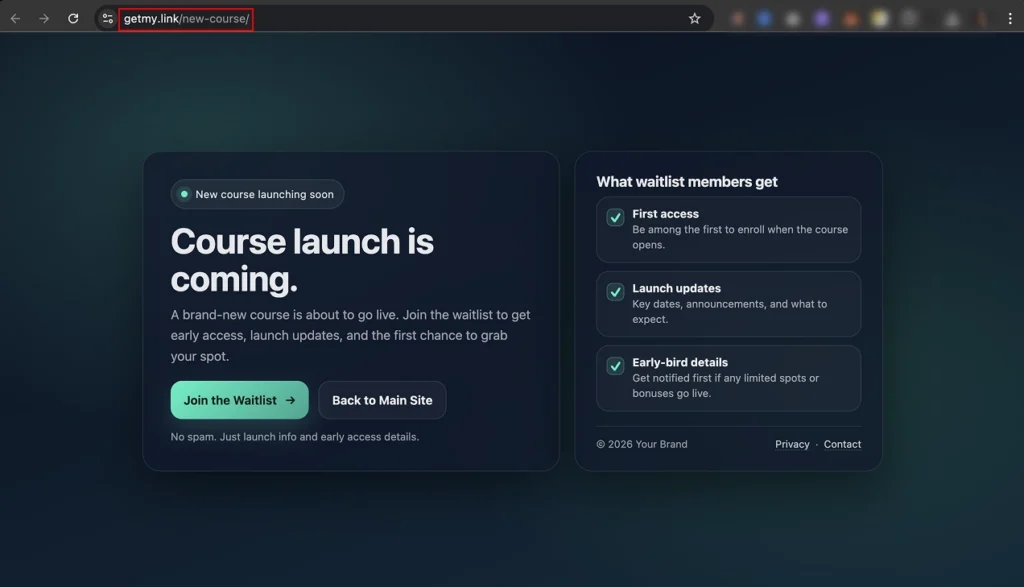
(Desktop version of a GetMy.Link static page promoting a new course launch and inviting users to join the waitlist.)
Step 3: Create the Product (Focus on Value Over Perfection)
Use tools that make creation fast:
- Canva for PDFs and guides
- Notion for dashboards
- Google Docs for structured content
- CapCut or Final Cut for video courses
- Loom for quick training videos
Perfection delays income.
Clarity creates income.
Your first product should aim to:
- Solve the problem clearly
- Be structured
- Be easy to consume
- Deliver a specific outcome
Production quality matters – but value matters more.
Step 4: Set Pricing Strategically
Pricing is psychology.
- Too low → signals low value.
- Too high → increases friction.
Consider:
- Audience income level
- Competitor pricing
- Depth of transformation
- Your authority in the niche
General ranges:
- Micro products: $5-$29
- Templates & guides: $9-$79
- Courses: $49-$499+
You can also test pricing by:
- Offering early-bird discounts
- Running launch promotions
- Bundling multiple products
Because GetMy.Link allows instant edits, you can update pricing campaigns without changing your social bio.
Step 5: Build Your Sales Structure
This is where most creators fail.
They upload the product – but don’t structure the path.
Your funnel should look like this:
- Social Media
↓
GetMy.Link
↓
Product Page
↓
Checkout
↓
Automated Delivery
Instead of linking directly to a checkout page, use GetMy.Link to:
- Introduce the product
- Add description or benefits
- Include testimonials
- Provide preview access
- Capture emails before checkout
- Track clicks and behavior
That extra layer increases confidence and conversion.
Step 6: Automate Delivery
After purchase, the buyer should receive instant access.
Options:
- Automated email with download link
- Secure file delivery link
- Membership login
- Private access page
GetMy.Link allows file links and structured delivery blocks that can simplify access.
Automation removes manual labor.
Manual labor limits scalability.
Step 7: Launch With Structure
When launching:
- Announce to your audience.
- Add product as primary button on GetMy.Link.
- Run limited-time positioning.
- Monitor analytics daily.
- Adjust messaging based on behavior.
Launch week is about momentum.
Because GetMy.Link provides click analytics, you can see:
- Which posts drive traffic
- Which platforms convert best
- Which button gets most engagement
Data improves future launches.
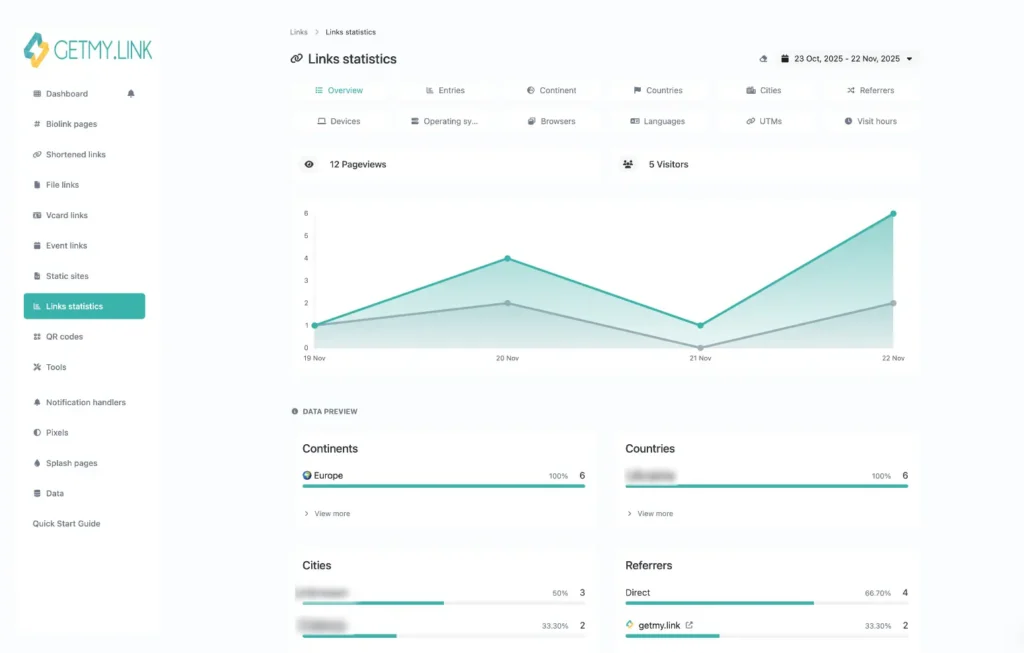
(Screenshot of GetMy.Link analytics panel showing link statistics.)
Step 8: Build a Retention Loop
One sale is good.
Repeat buyers are better.
After someone buys:
- Offer upsell
- Offer bundle
- Offer advanced course
- Add them to your email list
- Promote future launches
Your digital product ecosystem should expand.
With structured layering through GetMy.Link, you can:
- Add new products without clutter
- Create seasonal campaigns
- Feature bundles
- Segment audience behavior
Retention increases lifetime value.
The Difference Between Hobby Selling and System Selling
Hobby selling:
- Upload product → Share link → Hope.
System selling:
- Validate → Build → Structure → Launch → Track → Optimize → Retain.
The system scales.
The hobby stalls.
And the system always includes a centralized traffic hub.
Without one, you lose visibility into performance.
With one, you control growth.
How to Use GetMy.Link as Your Central Digital Product Hub
Most creators make the same mistake when they start selling digital products.
They create the product.
They generate a payment link.
They drop it into their bio.
And that’s it.
No structure.
No segmentation.
No tracking.
No system.
If you want to sell digital products consistently in 2026, your link can’t just “exist”.
It needs to function as infrastructure.
That’s where GetMy.Link becomes essential.
Not as a simple link-in-bio tool.
But as your digital storefront control layer.
Why You Shouldn’t Link Directly to a Checkout Page
Let’s say you create:
- An eBook
- A video guide
- A private tutorial bundle
- A preset pack
- A Notion template
If you link directly to:
- Gumroad
- Payhip
- Stripe
- Shopify
- Or a raw checkout page
You lose control over:
- How traffic is segmented
- What visitors see first
- Cross-sells
- Platform flexibility
- Analytics before checkout
- Retargeting opportunities
And once someone clicks away – they’re gone.
You have no buffer layer.
The Smart Flow for 2026
Instead of:
- Instagram → Checkout Page
You build:
- Instagram
↓
GetMy.Link
↓
Structured Product Options
↓
Checkout
↓
Retention Layer
That middle step changes everything.
What GetMy.Link Actually Lets You Do for Digital Products
- Create a clean landing view
- Add separate buttons for different digital products
- Reorder products anytime
- Highlight new releases
- Create limited-time offers
- Track clicks per product
- Attach Meta/Facebook Pixel
- Use UTM tracking for traffic source analysis
- Separate free lead magnets from paid products
- Keep branding consistent
It becomes your control center.
(For a complete step-by-step walkthrough with screenshots explaining every feature in detail, see the full GetMy.Link user guide on the blog.)
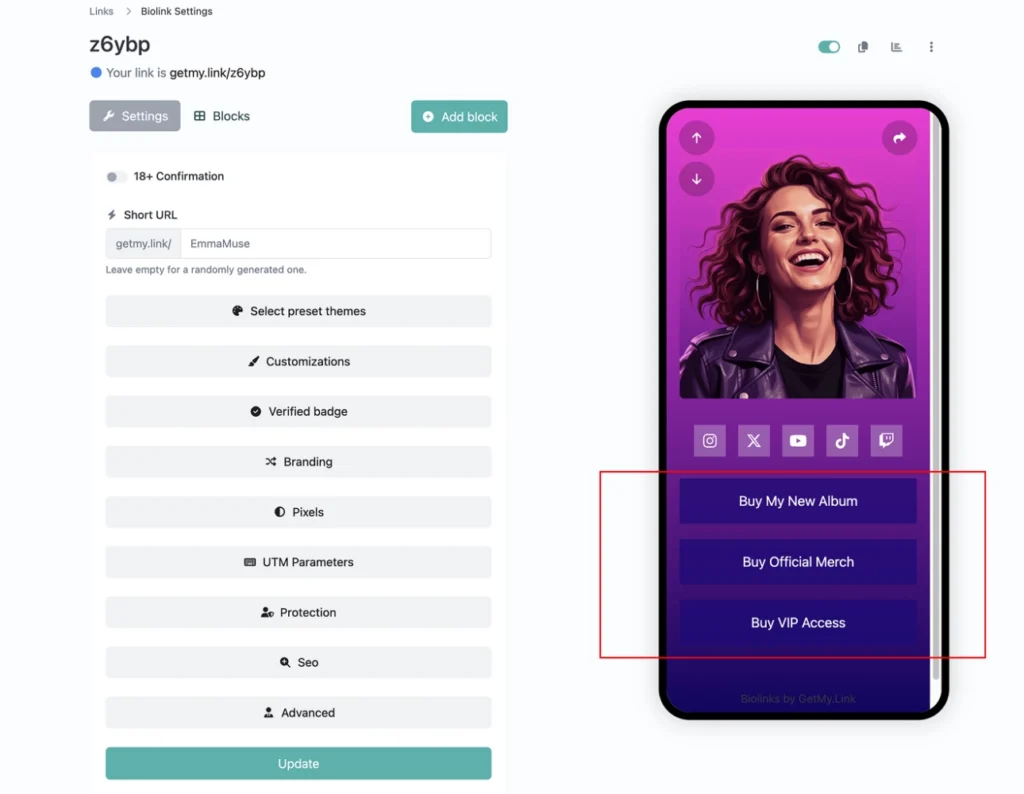
(GetMy.Link dashboard screenshot showing multiple digital product buttons organized in a clean biolink layout interface.)
You Can Update Without Breaking Your Funnel
One major advantage:
You never need to change your bio link again.
If you launch:
- A new course
- A seasonal product
- A flash sale
- A bundle
- A limited offer
You update it inside GetMy.Link.
Your Instagram, TikTok, YouTube bio stays stable.
Stability increases algorithm trust.
Tracking: The Real Advantage
This is where most creators fall behind.
If you don’t track:
- You don’t know which product gets clicks
- You don’t know which platform converts best
- You don’t know what bio wording increases traffic
- You don’t know what content drives buying intent
GetMy.Link analytics allow you to:
- Compare button clicks
- Monitor traffic volume
- Attach Meta Pixel
- Analyze performance by campaign
- Use UTM tags
This turns your digital product sales from guessing → into data-driven decisions.
Think Like a Brand, Not a Hobby Creator
Selling digital products online is no longer about:
- “Here’s my link, hope it sells”.
It’s about building:
- A structured link hub
- A clean landing layer
- Organized offers
- Measurable data
- Update flexibility
- Traffic control
That system is what scales.
And in 2026, scaling without infrastructure is almost impossible.
Your content attracts attention.
Your digital product creates value.
GetMy.Link connects both in a structured way.
Without it, you’re linking randomly.
With it, you’re building a monetization system.
How to Drive Traffic to Your Digital Products (Without Burning Out)
Creating a digital product is step one.
Structuring it inside GetMy.Link is step two.
But traffic is what activates the system.
In 2026, traffic isn’t about posting more.
It’s about guiding attention with intention.You don’t need to be everywhere.
You need a controlled flow.
Use Short-Form Content as Discovery
Short-form video is still the strongest discovery engine:
- Instagram Reels
- TikTok
- YouTube Shorts
But here’s the shift:
- You’re not selling the product inside the video.
You’re selling the click.
Instead of saying:
- “Buy my editing guide”.
You say:
- “Full workflow is linked in bio”.
Curiosity moves traffic.
Structure converts it.
Create Micro-Problem Hooks
Digital products convert best when they solve specific problems.
So your content should frame micro-problems:
- “Struggling to get views on Reels?”
- “Can’t figure out lighting?”
- “Posting daily but no growth?”
- “Editing takes too long?”
Then:
- “Complete breakdown in my bio”.
That bio link leads to GetMy.Link – not directly to checkout.
Why?
Because GetMy.Link lets you:
- Show multiple solutions
- Highlight your main product
- Capture leads first
- Track which problem attracts clicks
Use Stories to Warm Traffic
Feed content creates awareness.
Stories create intent.
In Stories you can:
- Show product previews
- Share testimonials
- Walk through the digital product
- Show behind-the-scenes creation
- Share results
And then:
- “Link in bio”.
Stories warm traffic before the click.
Warm traffic converts better.
Use Free Value as Entry Layer
One of the most powerful strategies in 2026:
- Lead with free value.
For example:
- Free PDF checklist
- Free mini guide
- Free template
- Free tutorial snippet
Inside GetMy.Link, you can structure:
- Free Resource
↓
Paid Full Version
This creates a layered funnel.
People trust you before paying.
Trust increases sales velocity.
Pin the Product in Your Content Ecosystem
Your digital product should appear:
- In pinned posts
- In story highlights
- In bio
- In YouTube descriptions
- In X posts
- In email footer
But all roads lead to one place:
- GetMy.Link.
Never split traffic across different links.
One hub.
Multiple entry points.
Use Data to Decide What to Push
Here’s where GetMy.Link becomes powerful.
After posting content, check:
- Which product button gets more clicks
- Which content drives more bio traffic
- Which campaigns convert best
If your Reel about “viral hooks” drives more clicks than your “editing workflow” video – push that topic harder.
Let data guide content.
Don’t Sell Every Day – Structure Every Day
Selling aggressively kills trust.
Structuring consistently builds authority.
Your goal isn’t to shout:
- “Buy my guide”.
Your goal is to build a clear path:
- Content → Curiosity → Bio → GetMy.Link → Product
When that path is smooth, you don’t need to hard sell.
Your system sells for you.
Traffic Is Attention. Structure Is Conversion.
Most creators focus on:
- “How do I get more views?”
Fewer ask:
- “What happens after the view?”
That’s the difference between:
Audience growth
and
Revenue growth.
Traffic without structure is noise.
Traffic with GetMy.Link becomes monetization flow.
Analytics & Optimization: How to Improve Sales Over Time
Selling digital products online isn’t a one-time launch.
It’s a system you refine.
Most creators stop at:
- “I made the product”.
- “I posted about it”.
- “I added the link”.
But real growth comes from optimization.
And optimization only works when you can see what’s happening.
That’s where GetMy.Link becomes more than a link hub.
It becomes your data layer.
Why Analytics Matter for Creators
If you don’t measure:
- You don’t know which product attracts clicks
- You don’t know which platform sends the best traffic
- You don’t know which bio wording converts better
- You don’t know what content creates buying intent
And without that information, you’re guessing.
Guessing slows growth.
Tracking speeds it up.
What You Should Be Measuring
Inside GetMy.Link, you can monitor:
- Total link clicks
- Button-level clicks
- Traffic spikes
- Campaign behavior
- UTM-tagged sources
- Pixel data (if connected)
This gives you visibility before checkout.
That’s important.
Because once someone leaves your bio link and lands on a payment processor, your control decreases.
GetMy.Link keeps visibility inside your ecosystem.
Use A/B Testing in Your Bio
Small wording changes matter.
Test:
- “Full Guide Below ↓”
vs
“Get the Complete Blueprint ↓”
Watch how clicks change inside GetMy.Link.
You don’t need complex software.
Your link hub becomes the measurement point.
Traffic Source Tracking with UTM
If you’re posting on:
- TikTok
- YouTube
- X
Use UTM parameters.
Example:
- Instagram link → getmy.link/yourname?utm=instagram
- YouTube link → getmy.link/yourname?utm=youtube
Inside analytics, you can see which platform drives more traffic.
Then:
Double down on the strongest channel.
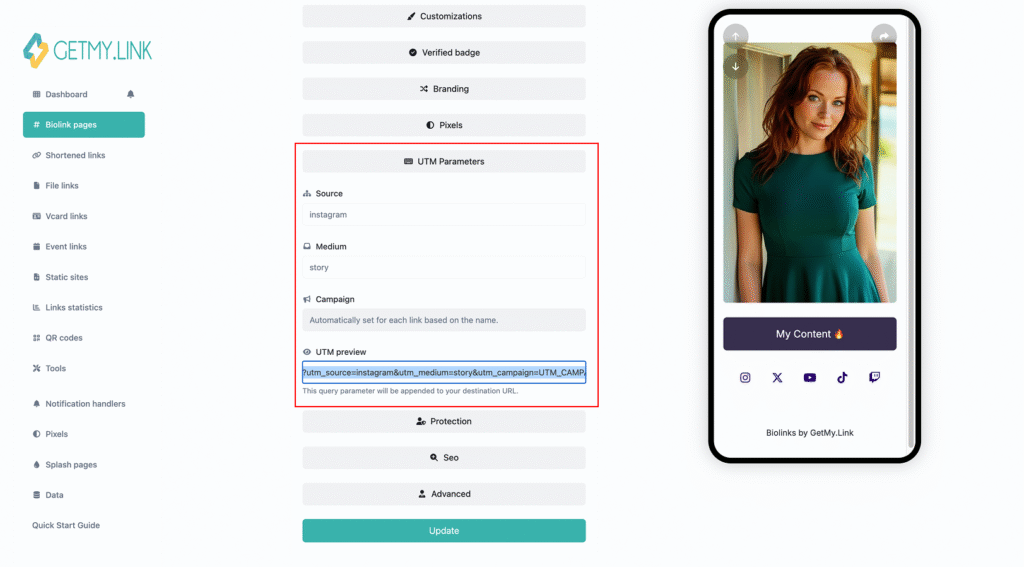
(Screenshot of the UTM Parameters section in GetMy.Link)
Meta Pixel Integration for Retargeting
Advanced creators connect Meta Pixel.
Why?
- Because not everyone buys on first click.
With Pixel connected through GetMy.Link:
- You can retarget visitors
- Run ads to warm audiences
- Track campaign effectiveness
Retargeting reduces cost per sale.
This is infrastructure-level thinking.
Look for Patterns, Not Daily Fluctuations
Don’t panic over one slow day.
Look at:
- Weekly trends
- Product click ratios
- Traffic spikes after content drops
- Conversion shifts after bio edits
Patterns reveal opportunity.
Single-day drops create stress.
Optimize the Order of Buttons
Position matters.
Most clicks go to:
- Top 1-2 buttons.
If your best product is buried fourth – it won’t perform.
Reorder inside GetMy.Link:
- Primary product at top
- Lead magnet second
- Secondary offers below
Structure influences behavior.
Remove What Doesn’t Convert
If a product gets:
- Low clicks
- Low interest
- Low engagement
Don’t keep it visible forever.
Either:
- Improve positioning
- Improve copy
- Improve product description
- Or remove it
Clarity converts better than clutter.
Think in Cycles
Traffic cycle:
- Content
↓
Bio
↓
GetMy.Link
↓
Product
↓
Data
↓
Refinement
↓
New Content
Each loop makes the system stronger.
Without tracking, the loop breaks.
With GetMy.Link, the loop stays measurable.
Revenue Grows When Systems Improve
Digital products are scalable.
But scalability depends on:
- Clean structure
- Data visibility
- Fast updates
- Measurable traffic
Creators who treat their link like decoration stay small.
Creators who treat it like infrastructure grow predictably.
Conclusion
Selling digital products online is no longer about uploading a file and hoping someone buys it.
In 2026, creators who earn consistently don’t just create products.
They build systems.
Your content generates attention.
Your digital product delivers value.
But your link is what connects the two.
If your bio link sends traffic directly to random checkout pages, you’re operating without structure.
No segmentation.
No tracking.
No flexibility.
No control.
That’s not scalable.
The creators growing fastest today use a layered approach:
- Content
↓
Profile
↓
GetMy.Link
↓
Organized product options
↓
Checkout
↓
Retention
GetMy.Link becomes the central control layer in that system.
It lets you:
- Organize multiple digital products in one place
- Separate free and paid offers
- Reorder products instantly
- Track button-level performance
- Use UTM tracking
- Connect Meta Pixel
- Update launches without changing your bio link
- Maintain clean, platform-safe branding
That’s not just convenience.
That’s infrastructure.
Digital products are powerful because they scale without extra time per customer.
But scaling without structure creates chaos.
Scaling with structure creates predictable revenue.
If you’re serious about selling digital products – courses, presets, templates, guides, exclusive content, toolkits – your link should not be an afterthought.
It should be your command center.
Leave a Reply