Running influencer campaigns today means handling dozens of links, multiple platforms, and constant pressure to prove results. Agencies need clean reporting for clients. Brands need to know which collaborations actually drive traffic, sign-ups, or sales. But when every creator shares links in different formats – bios, stories, captions, swipe-ups – tracking quickly becomes messy.
That’s where GetMy.Link fits naturally into modern campaign workflows. Instead of treating links as an afterthought, the platform turns them into measurable marketing assets. Agencies and brands use GetMy.Link to create trackable short links, organize campaigns by project, attach UTM data, and see real performance in one dashboard – without complicated setups or extra tools.
This article breaks down how agencies and brands use GetMy.Link for campaign tracking in real-world scenarios. From influencer seeding and paid collaborations to UGC campaigns and giveaways, you’ll see how teams simplify attribution, compare traffic sources, and make smarter decisions using link-level analytics. The focus is practical, not technical – clear examples, clean structure, and a system that scales as campaigns grow.
Why Traditional Campaign Tracking Breaks Down
On paper, tracking influencer campaigns sounds simple. Create a few links, add UTM tags, check analytics later. In reality, once campaigns scale beyond one or two creators, the system starts to crack.
Agencies and brands usually run into the same problems again and again.
First, links are created everywhere. Some live in spreadsheets. Others are buried in chat threads or email chains. One person builds UTMs manually, another copies an old link and edits it slightly. Over time, no one is fully sure which link belongs to which creator – or which campaign version is still active.
Second, UTM data becomes inconsistent. Different team members use different naming conventions. One campaign is tagged as spring_launch, another as SpringLaunch, and a third as spring2026. In analytics, these appear as separate campaigns, even though they refer to the same initiative. Reporting turns into manual cleanup instead of insight.
Third, attribution gets blurry across platforms. A creator might post on Instagram, add the link to their bio, and later reuse the same link in a story or on X. Without structured tracking, traffic sources blend together. You see clicks – but you can’t clearly explain where they came from or why one creator outperformed another.
Finally, reporting becomes slow and reactive. By the time results are pulled from analytics tools and summarized for clients or internal teams, the campaign is already over. There’s no easy way to adjust messaging, replace underperforming creators, or double down on channels that are working in real time.
This is the gap GetMy.Link solves. It gives agencies and brands a single system to create, organize, and track links from the start – before campaigns launch, not after they’ve already gone live.
How Agencies Structure Campaigns Inside GetMy.Link
Once agencies move campaign tracking into GetMy.Link, the first thing that changes is structure. Instead of thinking in isolated links, teams start thinking in campaigns, projects, and ownership.
Most agencies begin by creating a dedicated project for each campaign or client. A single project might represent a product launch, a seasonal promotion, or a long-term influencer partnership. Inside that project, every link, QR code, tracking pixel, and analytics view stays grouped together. This separation matters. It prevents data from different clients or campaigns from blending into one report and keeps accountability clear across teams.
Within each project, agencies generate individual short links per creator, platform, or placement. One influencer might receive separate links for Instagram bio, story swipe-ups, and TikTok captions. Another creator in the same campaign might only need a single link. Because all links live inside the same project, performance comparisons remain clean and immediate.
UTM parameters are usually standardized at the project level. Agencies define naming conventions upfront – campaign name, source, medium – and then reuse them consistently across every link. This avoids fragmented analytics later and ensures that reports reflect real performance rather than inconsistent tagging.
As campaigns scale, this structure becomes even more valuable. Teams can instantly see which creators are live, which links are active, and which traffic sources are producing results. There’s no need to dig through emails or spreadsheets. Everything connected to the campaign lives in one place, updated in real time.
For agencies managing multiple brands or high-volume influencer programs, this approach turns campaign tracking into a repeatable system rather than a one-off setup.
How Brands Use GetMy.Link to Track Influencer Performance
For brands, campaign tracking is less about process and more about answers. Which creator actually drives traffic? Which platform converts attention into action? Which collaboration is worth repeating – and which one quietly underperformed?
GetMy.Link gives brands a clear way to answer these questions without digging through complex analytics tools.
Most brands start by assigning a unique trackable link to each influencer. Even when multiple creators promote the same landing page, each one receives their own short link with embedded UTM data. From the outside, the links look clean and identical in purpose. Inside analytics, they tell very different stories.
As traffic comes in, brands can instantly see click volume per creator, broken down by source, device, and geography. This matters because raw numbers alone don’t tell the full picture. A creator might drive fewer clicks overall but deliver traffic from high-value regions or from platforms that historically convert better. GetMy.Link surfaces these patterns early, while campaigns are still running.
Brands also use link-level analytics to compare platform performance. Instagram bio links, story swipe-ups, TikTok captions, pinned comments – all of these placements behave differently. By assigning separate links to each placement, brands can see which formats actually motivate users to click instead of guessing based on impressions or views.
Another key advantage is speed. Instead of waiting until the end of a campaign, brands can monitor performance in near real time. If one creator is clearly outperforming others, budgets can be adjusted, posts can be boosted, or additional content can be commissioned while momentum is still high. Poorly performing links can be paused or replaced before wasting more exposure.
Over time, this data builds a performance history. Brands begin to recognize which creators consistently deliver quality traffic, which platforms align best with their audience, and which campaign types deserve more investment. Tracking stops being a reporting task and becomes a decision-making tool.
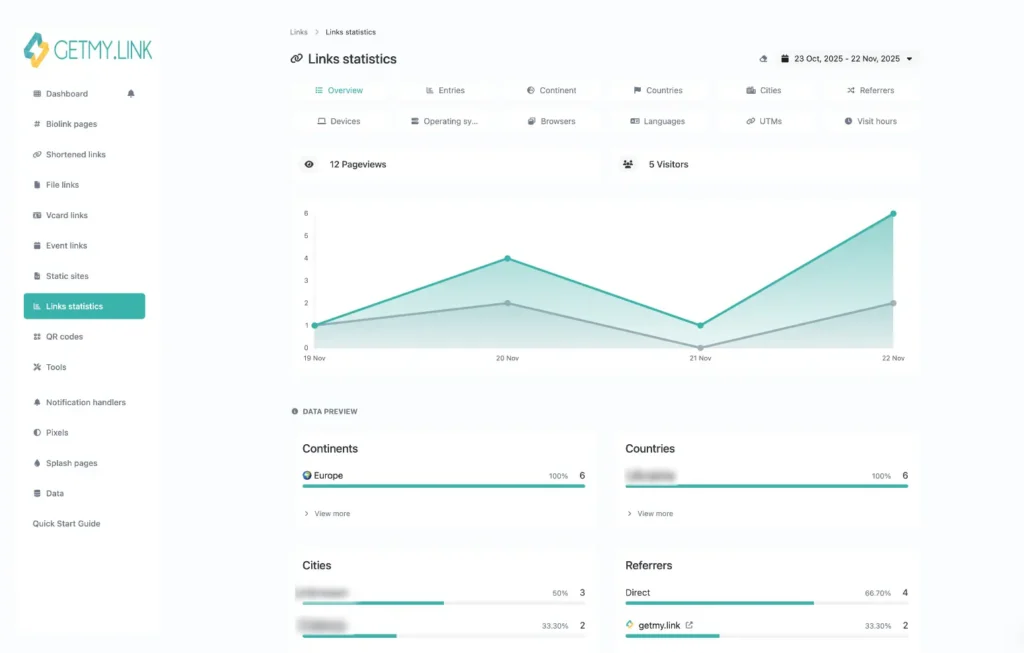
(Screenshot of GetMy.Link analytics panel)
Tracking UTM Data Without Manual Work
UTM tracking is powerful, but it’s also one of the biggest sources of friction in campaign setup. Manually building URLs, copying parameters, and double-checking naming conventions takes time – and small mistakes can break reporting later.
GetMy.Link removes most of this friction by treating UTM data as part of the workflow, not an extra step.
Instead of pasting long URLs into spreadsheets, agencies and brands create short links directly inside the platform and attach UTM parameters in a structured way. Campaign name, source, medium, and content fields are clearly separated. This reduces human error and keeps naming consistent across all links in the same campaign.
Once UTMs are defined, they can be reused. Teams don’t need to rebuild parameters for every new influencer or placement. The campaign stays the same. Only the source or content tag changes. This is especially useful for large influencer programs where dozens of links are created in a short time.
Another advantage is visibility. Because UTM data is stored with each link, anyone on the team can immediately see which tags are applied and why. There’s no guessing later about what a link was meant to track or whether it’s safe to reuse. This transparency makes collaboration smoother between account managers, media buyers, and brand-side teams.
On the reporting side, structured UTM data means cleaner analytics. Campaigns appear exactly as intended in traffic reports, without fragmented naming or duplicate entries. Brands can confidently compare results across creators, platforms, and time periods, knowing the data is consistent.
By removing the manual work around UTMs, GetMy.Link lets teams focus on interpreting results instead of fixing tracking mistakes after the fact.
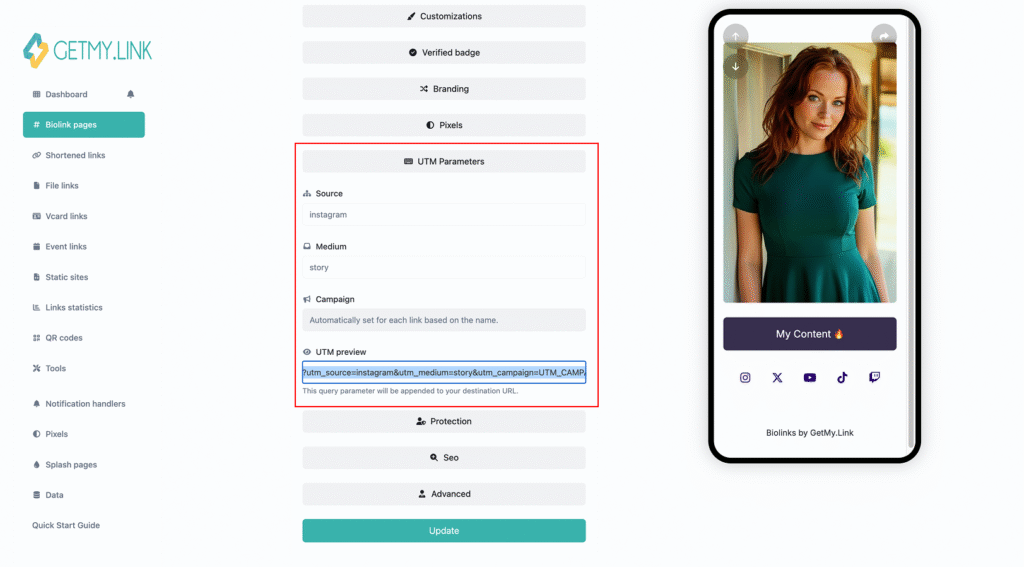
(Screenshot of the UTM Parameters section in GetMy.Link)
Using GetMy.Link Analytics for Real-Time Campaign Decisions
Campaign data is most valuable while a campaign is still live. Once it’s over, insights turn into post-mortems. GetMy.Link shifts analytics from a reporting tool into a real-time decision engine.
As soon as links go live, teams can see traffic appearing in the analytics dashboard. Clicks update continuously, making it easy to spot patterns early. If one creator’s link starts outperforming others within the first hours or days, that signal doesn’t get buried until the end of the campaign.
Agencies often use this visibility to optimize campaigns on the fly. High-performing creators may receive additional budget, extra placements, or follow-up collaborations. Underperforming links can be paused, replaced, or adjusted before wasting more exposure. This flexibility is especially important in short-term launches, flash sales, and time-sensitive promotions.
Brands also rely on real-time analytics to understand how audiences behave, not just how many clicks they generate. Device data reveals whether traffic is mostly mobile or desktop. Geographic breakdowns show which regions are responding best. Referral insights help confirm whether creators are using the correct placements and platforms.
Another advantage is internal alignment. Because analytics live inside GetMy.Link, both agency teams and brand stakeholders can look at the same data without exporting reports or granting access to external tools. Conversations shift from “can you pull the numbers?” to “what should we do next?”
Over time, these live insights help teams move faster and smarter. Decisions are based on what’s happening now, not what happened weeks ago.
Campaign Types That Work Especially Well with GetMy.Link
Not every campaign runs the same way. Some focus on reach, others on engagement or conversions. What makes GetMy.Link especially useful is how easily it adapts to different campaign formats without changing the core setup. The same tracking structure works across short-term launches, long-term partnerships, and community-driven promotions.
Influencer Seeding Campaigns
Product seeding campaigns often involve many creators posting casually rather than following strict posting schedules. That flexibility is great for authenticity, but difficult for tracking. GetMy.Link solves this by assigning one trackable link per creator, even when all links lead to the same destination.
Because every link lives inside the same project, brands can quickly see which creators generated real interest and which posts resulted in little to no traffic. This makes follow-up decisions simple – high-performing creators can be re-engaged for paid collaborations, while others remain one-off partners.
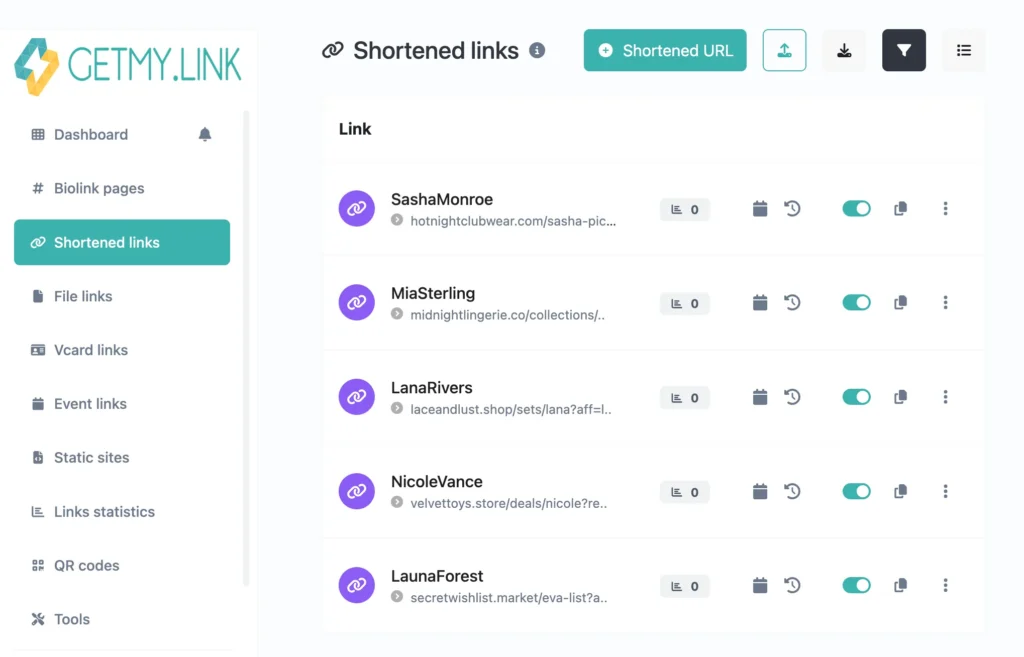
(Screenshot of the GetMy.Link dashboard in the “Shortened links” section, showing a brand manager account with multiple short links created for different OnlyFans models, each linked to a separate affiliate destination URL.)
Paid Influencer Collaborations
In paid campaigns, performance clarity is critical. Brands need to justify spend, and agencies need clean data for client reports. GetMy.Link allows teams to separate creators, platforms, and placements by using different links with structured UTM parameters.
Instagram bio links, story swipe-ups, TikTok captions, and pinned comments can each have their own tracking link. This makes it easy to compare not just creators, but also formats. Over time, brands build a clear picture of which combinations deliver the strongest results.
This structure also helps avoid disputes. When everyone sees the same link-level data, conversations stay objective and data-driven.
UGC and Community-Driven Campaigns
User-generated content campaigns often rely on volume rather than individual performance. Dozens or even hundreds of users may share a link as part of a challenge, giveaway, or referral program. GetMy.Link keeps this manageable by grouping all UGC links under one campaign while still allowing segmentation by source.
Brands can track which platforms drive the most engagement, which regions respond best, and how traffic behaves overall. Even without tracking every individual user, the campaign-level insight remains clean and actionable.
Giveaways and Limited-Time Promotions
Giveaways and flash promotions benefit from fast setup and clear tracking. GetMy.Link allows teams to spin up short links quickly, reuse campaign UTMs, and distribute links across creators and platforms without confusion.
Because all data is centralized, brands can see which channels drive urgency and which placements fail to convert attention into action. This helps refine future promotions and avoid repeating ineffective formats.
Across all these campaign types, the advantage stays the same: clear structure, consistent tracking, and insights that don’t require manual cleanup. GetMy.Link adapts to the campaign – not the other way around.
How GetMy.Link Simplifies Reporting for Agencies and Brands
Reporting is often where campaign tracking falls apart. Data lives in multiple tools, links are hard to trace back to specific creators, and reports take longer to build than the campaigns themselves. GetMy.Link simplifies this process by keeping all link data in one place, already structured and ready to review.
For agencies, this means faster client reporting. Instead of exporting data from multiple platforms and matching links manually, teams can open a project and immediately see how each creator and placement performed. Click counts, traffic sources, and geographic data are already organized by link, reducing the need for extra spreadsheets or post-campaign cleanup.
Brands benefit from clearer performance summaries. Rather than scrolling through raw analytics dashboards, decision-makers can focus on which collaborations delivered value. The data is easy to interpret because it mirrors how campaigns were structured from the start – by creator, platform, or promotion type.
Another advantage is consistency. When every campaign follows the same link structure, reports look familiar from one launch to the next. This makes it easier to compare results over time and spot long-term trends instead of treating each campaign as a standalone experiment.
GetMy.Link also supports collaboration around reporting. Both agency teams and brand stakeholders can access the same data view, reducing back-and-forth questions and misaligned interpretations. Reporting becomes a shared reference point rather than a one-off document sent at the end of a campaign.
By simplifying how performance data is collected and presented, GetMy.Link turns reporting from a bottleneck into a natural extension of campaign execution.
Conclusion
Campaign tracking doesn’t have to be complicated to be effective. For agencies and brands running influencer and performance-driven campaigns, the real challenge is not collecting data, but keeping it structured, consistent, and useful while campaigns are still active.
GetMy.Link solves this by turning links into a clear tracking system rather than scattered URLs. Campaigns are organized from the start. Creators and platforms are separated cleanly. UTM data stays consistent. Analytics remain easy to read without additional tools or manual cleanup.
For agencies, this means scalable workflows and faster reporting. For brands, it means confidence – knowing which collaborations perform, which channels deserve more investment, and which strategies should be adjusted or dropped entirely.
Whether it’s influencer seeding, paid collaborations, UGC campaigns, or limited-time promotions, GetMy.Link adapts to different campaign types without changing the core setup. Tracking becomes a natural part of the campaign process, not a task left for the end.
In a marketing landscape where clarity and speed matter more than ever, GetMy.Link gives agencies and brands a practical way to track performance, make informed decisions, and build campaigns that improve with every launch.
Leave a Reply