
TikTok has become one of the fastest ways for creators to get attention online. A single video can reach thousands – sometimes millions – of viewers in a matter of hours. For many OnlyFans creators, it’s the first platform they turn to when trying to grow from zero.
But that kind of growth comes with trade-offs.
Reach on TikTok is highly unpredictable. A video can go viral one day and barely get seen the next, even with the same content style. Accounts can get limited or removed without clear explanations. And while the platform is great for visibility, turning that attention into actual traffic and paying subscribers is much harder.
Another challenge is how short-lived everything feels. Content moves quickly, trends change constantly, and maintaining consistent results requires continuous output. That makes it difficult to build something stable over time.
At the same time, creators are rethinking how growth works. Rather than depending on one platform to handle everything, they’re building structured systems – combining multiple traffic sources, link hubs, and monetization tools that work together.
This change is what’s pushing creators to look for TikTok alternatives. Not just another place to post, but a more reliable way to attract attention, guide users, and convert them into long-term supporters.
Why TikTok Alone Isn’t Enough for Creators
For a while, TikTok felt like the easiest way to get noticed.
Post short videos, follow trends, and let the algorithm do the work.
And it works – up to a point.
The main issue is that TikTok reach is inconsistent. A video can perform extremely well one day and get almost no visibility the next. Even when the content stays similar, results can vary a lot.
That makes growth hard to predict.
Another challenge is moderation. TikTok has strict rules around adult or suggestive content. Even borderline material can lead to reduced reach, content removal, or account restrictions. In some cases, entire profiles disappear without a clear explanation.
Conversion is another weak point.
TikTok is designed for fast scrolling. People watch, like, and move on. Getting them to leave the app, click a link, and take action requires extra steps – and many users simply don’t follow through.
There’s also the issue of content lifespan.
Most videos peak quickly and then stop getting views. Unlike platforms where content can continue bringing traffic over time, TikTok often requires constant posting just to maintain visibility.
All of this creates a pattern.
Creators can get attention, but that attention doesn’t always turn into something stable. Growth depends on the algorithm, results are inconsistent, and income becomes harder to predict.
That’s why more creators are starting to treat TikTok as just one part of a larger system – not the foundation of their entire strategy.
Rethinking Growth Beyond TikTok
When creators start looking for TikTok alternatives, the first instinct is to find another platform that can replace it.
Something with the same reach, the same speed, and fewer restrictions.
But that way of thinking doesn’t solve the real problem.
The issue isn’t TikTok itself. It’s relying on a single platform to handle everything – discovery, engagement, and conversion – all at once.
A better approach is to separate those roles.
Rather than looking for a one-to-one replacement, creators build a structure where each part serves a clear purpose.
In practice, this usually comes down to three layers:
Traffic platforms – where people discover you
These are platforms like TikTok, X, or Reddit. Their role is simple: bring attention and attract new users.
Conversion hubs – where people click and take action
This is where your links live. Instead of sending traffic directly to OnlyFans, creators use a central page that organizes everything in one place and makes it easier for fans to decide what to do next.
Monetization platforms – where content is sold
OnlyFans is still the main one, but many creators now use additional platforms to diversify income and reduce risk.
No single platform should carry the entire process on its own.
TikTok is powerful for reach, but it doesn’t work well as a full system on its own.
Results become more consistent when each layer supports a specific part of the process.
Attention comes from one place. Clicks happen in another. Revenue comes from a separate platform.
With this setup, changes on one platform no longer disrupt the overall flow.
X (Twitter) – A More Direct Way to Drive Clicks
X plays a very different role compared to TikTok.
While TikTok is built around viral reach, X is built around visibility and direct interaction. Content doesn’t disappear as quickly, and posts are not as tightly controlled by a single algorithm.
That creates a more predictable flow of traffic.
One of the biggest advantages is how links work.
On X, creators can include links directly in their posts without the same level of restriction. Users are also more used to clicking external links, which makes it easier to move traffic outside the platform.
Another difference is how content spreads.
Posts can travel through reposts, replies, and conversations. Even a single tweet can keep bringing views and clicks over time if it continues to get engagement.
The format is also more flexible.
Content doesn’t have to be highly polished. Short updates, casual posts, and direct interaction all perform well. That makes it easier to stay consistent without constantly producing high-effort videos.
At the same time, X is not meant to replace TikTok.
It works best as a traffic layer.
The goal isn’t to go viral, but to stay visible, interact with your audience, and guide people toward your link hub, where everything is structured and easier to explore.
Used this way, X helps balance out the volatility of platforms that rely on sudden spikes in reach.
Pro Tip: Post consistently and interact with replies. Conversations often bring more visibility than standalone posts.
Reddit – Where Niche Communities Drive Real Traffic
Reddit works very differently from TikTok.
It’s not based on trends or short bursts of attention. It’s built around communities where people actively look for specific types of content.
That’s what makes it valuable.
Rather than chasing random attention, creators can reach users who already have interest in a particular niche. These communities – known as subreddits – are often very focused, which means the traffic coming from them is more targeted.
And targeted traffic is much more likely to convert.
Another key difference is how long content stays visible.
On TikTok, most videos lose momentum quickly. On Reddit, a post can continue bringing views and clicks for days or even weeks, especially if it gets early engagement.
This allows traffic to build up over time instead of disappearing after a short burst.
The approach here is more structured.
Creators usually post in multiple relevant subreddits, adapting their content to match each community. Titles matter, timing matters, and understanding what works in each space makes a big difference.
It takes some testing, but once you find the right communities, Reddit can become a reliable traffic source.
Reddit isn’t designed for direct conversion. Its role is to move interested users toward your link hub, where everything is organized and easier to navigate.
Pro Tip: Focus on relevance over volume. Posting in the right communities with tailored content works much better than posting everywhere at once.
YouTube – Turning Short-Term Reach Into Long-Term Traffic
One of the biggest limitations of TikTok is how short-lived the results are.
A video can get strong reach, but the effect often fades quickly. Once the initial wave passes, traffic slows down, and the content stops bringing new viewers.
YouTube works differently.
Even short-form content like YouTube Shorts can continue getting views over time. Instead of disappearing after a day or two, videos can keep generating traffic days, weeks, or even months later.
That creates a more stable foundation.
Another advantage is how content is connected.
On TikTok, most videos exist on their own. On YouTube, viewers can move from one video to another, explore your channel, and spend more time with your content. That builds familiarity and increases the chances of them taking action.
There’s also a stronger search component.
Unlike TikTok, YouTube content can be discovered not only through recommendations but also through search. That means your videos can attract new viewers long after they were published.
For creators, this opens up a different strategy.
Beyond constant posting, you can build a library of content that continues working in the background.
At the same time, YouTube doesn’t replace TikTok.
It complements it.
TikTok brings fast attention. YouTube helps turn that attention into something more stable and long-term.
Pro Tip: Reuse your TikTok videos as Shorts, but adjust captions and titles to make them work better within YouTube’s search and recommendation system.
Moving Beyond a Single Monetization Platform
TikTok can bring a lot of attention, but attention alone doesn’t create stable income.
That’s one of the biggest limitations creators start to notice over time.
OnlyFans remains the primary platform most creators rely on. It has a large audience and a familiar subscription model. But relying on a single platform comes with risk.
Restrictions can appear without warning. Platform rules shift over time. Payment systems can also change unexpectedly. Even small updates can affect how creators earn.
When traffic already depends on TikTok’s algorithm, adding another layer of dependency makes the entire system unstable.
Because of this, many creators are no longer limiting themselves to a single platform.
Rather than keeping everything in one place, they use additional platforms that offer similar features – subscriptions, messaging, and paid content – but with different audiences and tools.
This approach gives them more room to adapt.
If one platform slows down, others can continue bringing in income. It also gives fans more options, depending on what they prefer.
Some platforms focus on discovery. Others offer more content freedom or different pricing structures. That variety can open up new opportunities without replacing what’s already working.
At the same time, some creators are moving even further.
They start using their link-in-bio not just as a navigation tool, but as a direct monetization layer.
With the right setup, it becomes possible to sell access, share paid content, and deliver media directly to fans – without depending entirely on a single platform.
Tools like GetMy.Link support this approach by allowing creators to connect payment systems, share files, and organize paid offers in one place – without taking commissions on earnings.
The goal isn’t to replace OnlyFans.
It’s to reduce dependency – and gain more control over how you earn.
Multiple income streams make the overall setup far more resilient.
Pro Tip: Don’t try to expand everywhere at once. Add one new platform or monetization method, test how it performs, and scale only what works.
Creating a System That Works Across Platforms
At this stage, the focus shifts away from finding a single replacement.
It’s about how everything works together.
The most effective creators don’t build their strategy around a single platform. They build a simple system where each platform has a clear role.
Some platforms bring attention. Others bring clicks. A separate layer handles conversions. And monetization happens on one or more dedicated platforms.
When these parts are connected, the system becomes much more resilient.
A simple structure often looks like this:
- TikTok for reach
- X and Reddit for traffic
- a central page that connects everything
- OnlyFans and other platforms for monetization
Each layer feeds into the next step in the flow.
Traffic moves from discovery platforms into a single destination. From there, users choose where to go next. Everything is organized in one place, which makes the experience smoother and increases the chances of conversion.
This also changes how you think about growth.
Your presence is distributed across multiple channels instead of being tied to one algorithm. If one platform slows down, the rest of the system continues to work.
This is what makes an ecosystem approach more reliable.
You’re no longer reacting to platform changes. You’re creating a structure that can adapt to them.
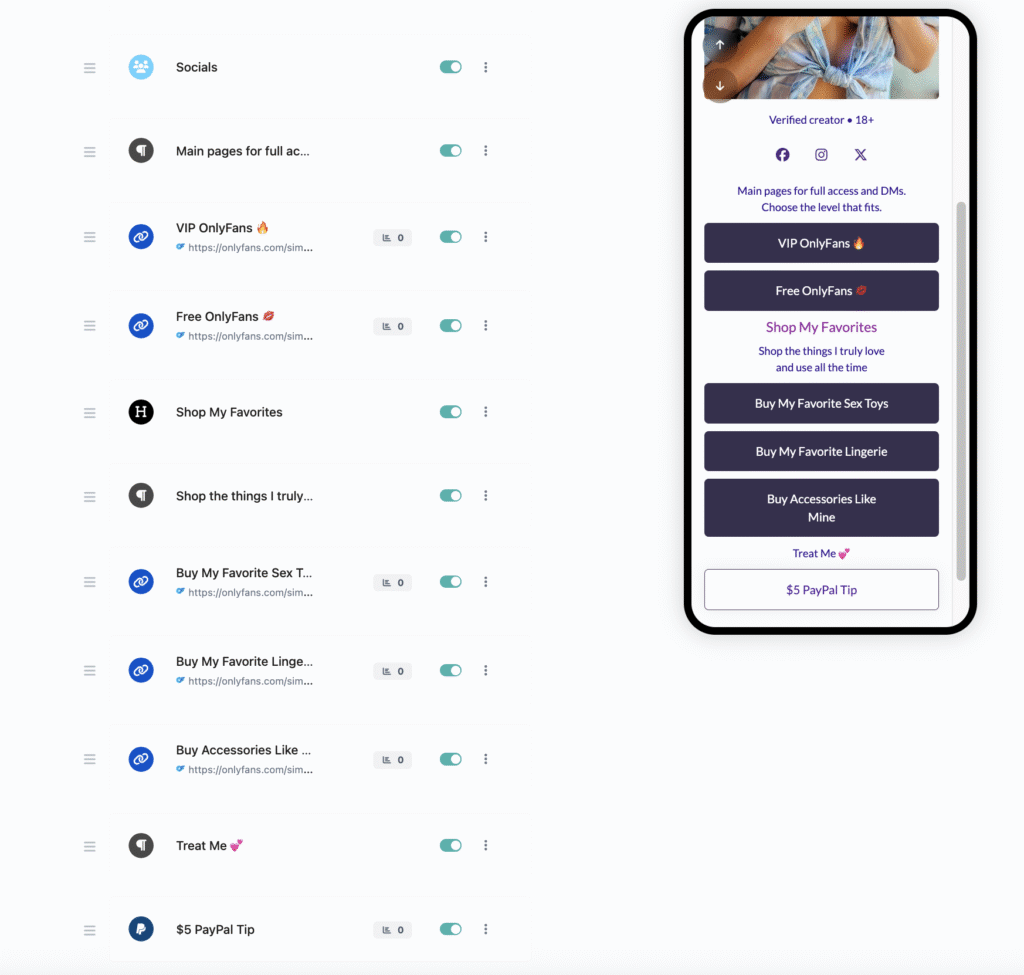
At the core of this setup, everything connects in one central place.Pro Tip: Track where your traffic comes from. Even simple analytics can show which platforms bring the most engaged users, helping you focus your effort where it matters most.
Your Link Hub as the Core of Your System
Once traffic starts coming in from TikTok and other platforms, the next step becomes clear: where do you send it?
No matter where someone discovers you, they need a single place to land. And that place should be something you fully control.
This is where link-in-bio tools become a key part of the system.
TikTok, in particular, makes this even more important. Links are limited, and most users will only see one entry point – your bio. That means every click matters.
Many creators start with basic tools that allow them to list a few links. But for OnlyFans creators, that setup is often too limited. Some platforms restrict certain types of content. Others add extra steps before users can access links.
That adds unnecessary steps – and every extra step reduces the chance of conversion.
A more effective approach is to use a link hub that gives you flexibility and full control over how your content is presented.
Platforms like GetMy.Link take this further.
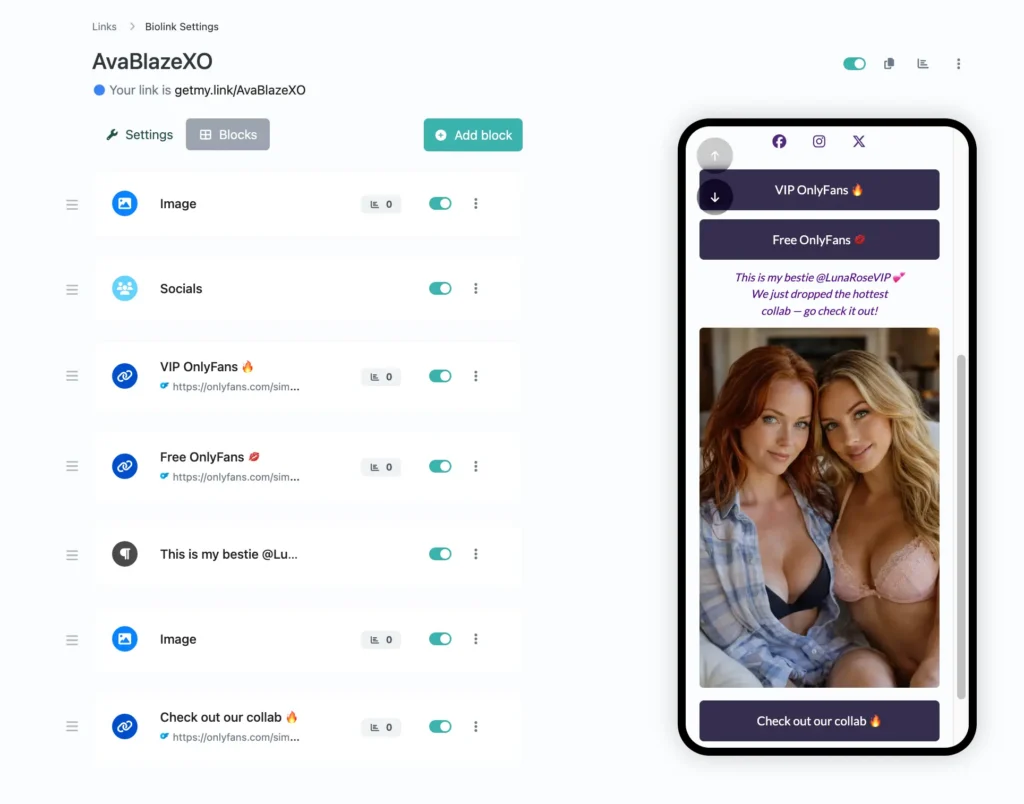
Rather than functioning as a simple list, it allows you to build a structured page that can include multiple platforms, offers, and content in one place. Fans don’t have to guess where to go next – everything is clearly organized.
It also opens up additional opportunities.
Your page can include paid offers, media previews, and direct delivery of content. Combined with connected payment systems, this turns your link hub into a working monetization layer, not just a navigation tool.
Another major advantage is visibility.
The content on your page can be indexed by search engines. That means your link hub can attract visitors even outside of social platforms, adding another layer of traffic over time.
Most importantly, this setup gives you independence.
By not relying on a single platform, you create a central point that connects everything. If one traffic source slows down, the rest of your system continues to work.
Pro Tip: Create different versions of your link page for different traffic sources. Adjust messaging and offers depending on where users come from to improve conversions.
Conclusion
TikTok is one of the fastest ways to get attention, but attention alone is not enough to build something stable.
Reach can change at any moment. Results are difficult to predict. And turning views into consistent income requires more than just viral content.
That’s why more creators are starting to shift their approach.
Rather than treating TikTok as the center of their growth, creators now position it as just one element within a broader system. Some platforms bring visibility. Others bring more targeted traffic. And a separate layer handles conversions in a more structured and controlled way.
This makes the overall strategy far more predictable.
When one platform slows down or changes its rules, it doesn’t break everything. Traffic can still come from other sources, and your core setup continues to work.
The shift is subtle but important.
The goal isn’t to swap TikTok for another platform. It’s about building a structure where each part has a clear role – and where everything connects in one place you control.
That’s what allows creators to grow more consistently, with less risk and more flexibility over time.